
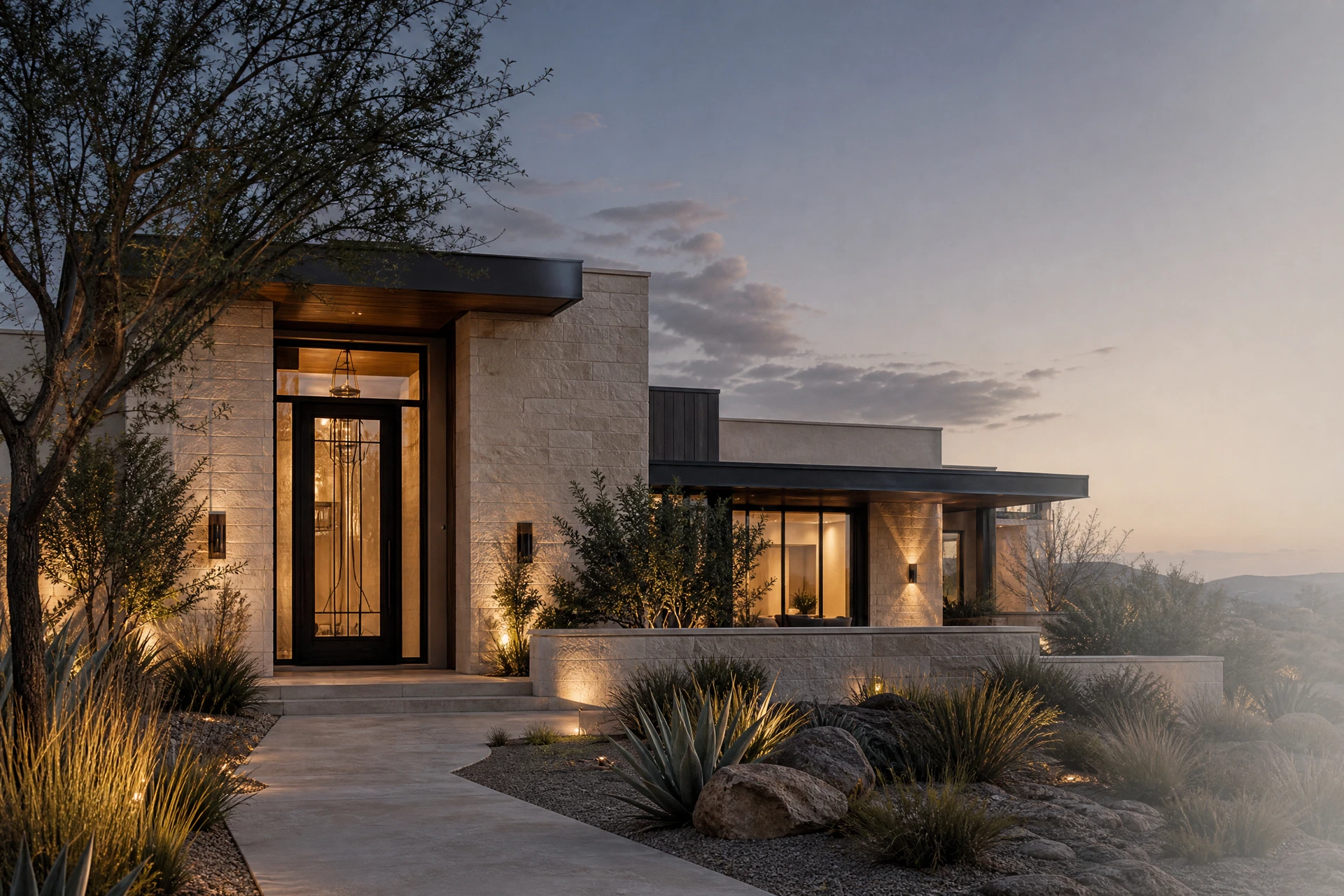
An entry door does more than close an opening. It establishes the visual weight of the arrival, controls the first exchange of light and privacy, and has to work with the real conditions of the wall around it. The most useful early choice is not a decorative pattern. It is a clear reading of the home, the opening, and the way the entry will be used.
Start with the wall, not the product card
Step back far enough to see the full elevation. Notice the roofline, nearby windows, cladding, porch depth, approach, foyer beyond, and how much visual weight the opening needs to carry. A door can be attractive on its own and still feel too small, too ornate, or too dark once it is placed in the larger composition.
Photographs of the full facade, not only the existing door, make this first conversation more useful. If plans or an elevation exist, bring them too. The goal is to understand the relationship before narrowing the product family.
Decide what the entry needs to do
Every household balances a different mix of arrival, daylight, privacy, circulation, and daily use. Think through the questions before comparing glass or hardware:
- How much of the foyer should be visible from the street?
- Which direction should the active leaf swing, and what needs to clear inside and outside?
- Is a single, double, pivot, sidelight, or transom composition appropriate for the wall?
- Will the door be used as the primary daily entrance, a formal arrival, or both?
These questions do not replace a field review. They create a stronger basis for the next decision.
Verify the opening before ordering
A rough width and height are useful at the beginning. They are not an order-ready specification. Jamb depth, floor condition, threshold detail, wall construction, trim, swing clearance, and the responsible field-verification process all matter before a final decision is made.
Use published dimensions as a way to compare candidates, then have the selected unit evaluated against the actual opening. A ready-to-buy door can be the right path when the documented configuration fits the project. A custom brief is more useful when the wall, proportion, operation, or design needs a purpose-built response.
Choose glass from both sides of the wall
Glass changes what the entry feels like from the street and from the foyer. Clear, textured, reflective, low-emissivity, and switchable options each need to be considered against visibility, interior daylight, exposure, and the architecture of adjacent windows. Avoid assuming a category photo answers the final privacy or performance question for a specific unit.
When possible, use the exact product details, then compare them with the facade and the rooms behind the entry. That sequence keeps the decision grounded in the opening rather than a sample alone.
Use Door Match to organize a first brief
If the opening is still taking shape, Find My Door Match turns a few practical inputs—project type, rough opening, configuration, finish, glass, screen, operation, and timing—into a more focused starting direction. It is designed to clarify the next product conversation, not to replace final field conditions or qualified installation.
From there, review the current iron entry door collection, explore the custom door path, or read how the broader project process keeps decisions connected as the opening becomes real.